
two months into 2026
thoughts on the two-headed calf

Hello, friends! Forgive me: our monthly reflection is not quite as punctual as last month, but we shall ascribe that to the brief charm of February. Although I confess, my tardiness is, in part, because this February has been particularly strange. Ramadan hasn’t felt so, although I can’t quite pinpoint why (perhaps we’ll circle back in March)— anyways, I thought I should sit with the poem I chose for this month:
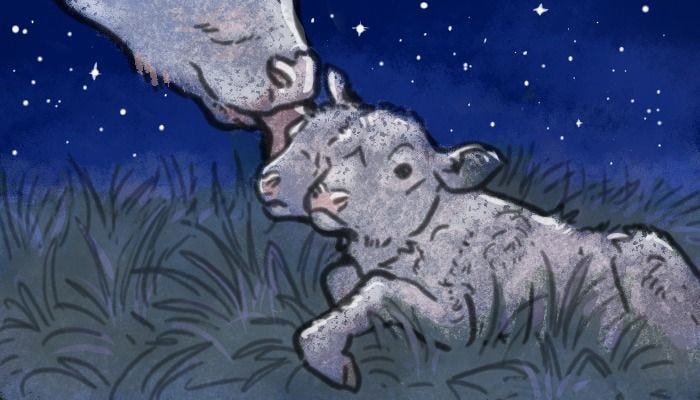
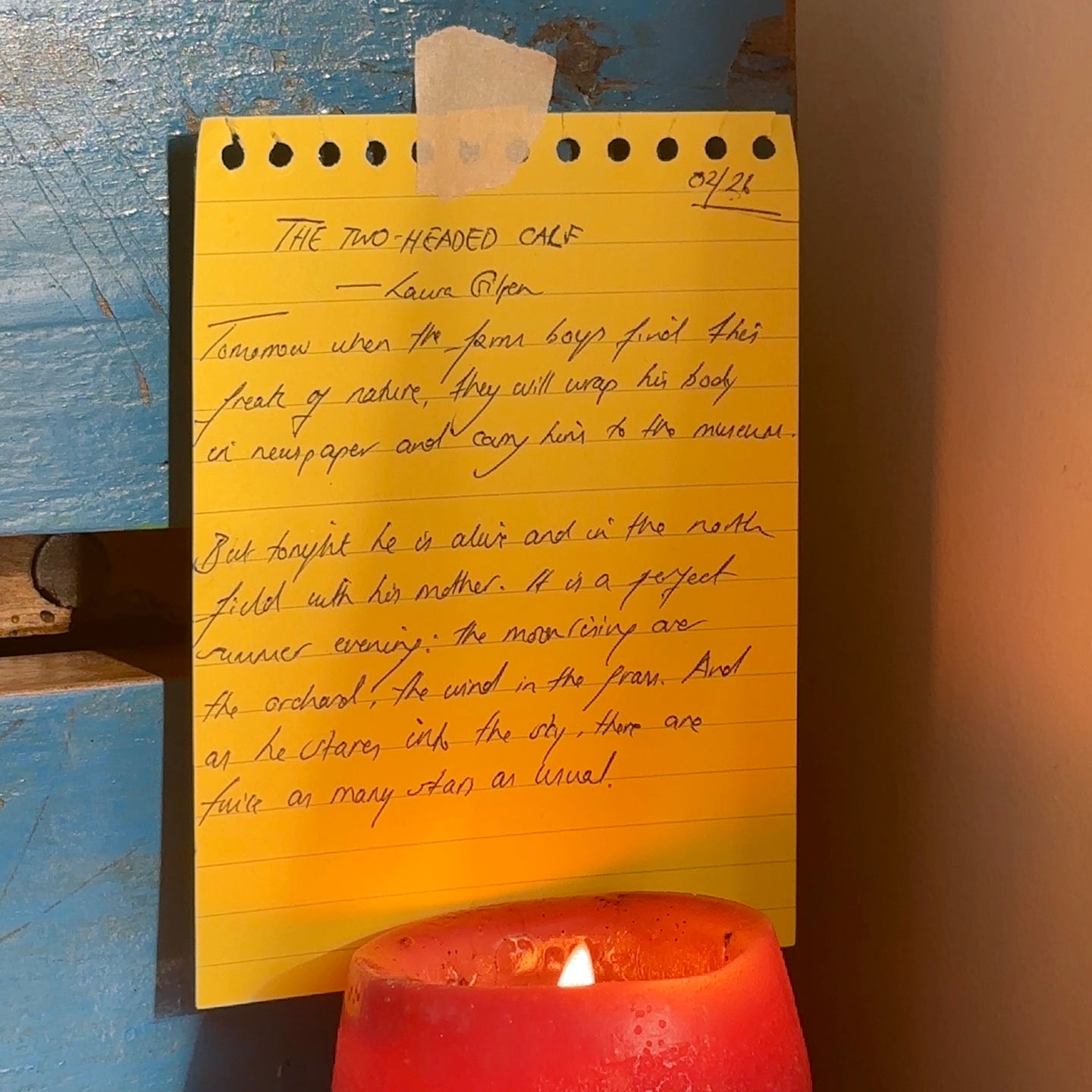
Tomorrow when the farm boys find this
freak of nature, they will wrap his body
in newspaper and carry him to the museum.
But tonight he is alive and in the north
field with his mother. It is a perfect
summer evening: the moon rising over
the orchard, the wind in the grass.
And as he stares into the sky, there
are twice as many stars as usual.
Laura Gilpin, “The Two-Headed Calf”
When I first read this poem, years ago, I burst into tears. The sanctity of that tenderness, of the baby and his mother staring up at the stars, unaware or uncaring about his deformities, only to meet ridicule in the morning. Those four eyes, what did they see? How did he die?
I took it for granted that he was slaughtered, a trophy slung on the backs of brawny farm boys who were long since desensitised to the grief of the mother cow, who may even respond with a kick or a crack of the whip if she dares kick up a fuss to her calf being taken away. I saw what was not said as if it happened in front of me: the confused calf mewling for his mother, bowlegged from bearing the weight of two heads, dying in distress. I saw the farmers boys unveil the freak of nature like a triumph, perhaps even posing for pictures like when they’ve caught a particularly large fish.
I carried that calf’s grief for years, bothered by the indignity of it, unable to stop my eyes from watering anytime I came across that poem. Until one day I brought it up to my therapist. He probed, wanting to understand what it was about this poem that provoked such a visceral response. I told him that it was an injustice, that this beautiful, blameless creature should die young because he was born outside of what they thought he should look.
My therapist suggested something rather radical for me. This was early on and I was still quite unconvinced in the process, having tried with three other therapists before him. He said, “Could he not have just… died throughout the night? Did you consider that the farmboys found him like that?” I was floored. It hadn’t occurred to me for a second that the calf, born with such a genetic defect, could’ve just passed away from natural causes. That one moment he was looking up at the stars, and the next, he was gone. That the moment was… unmarred. That the freak of nature died a natural death come morning, but in those precious few hours of life, saw twice as many stars.
I was startled by how fixed my reading had been, for all that time. What unsettled me wasn’t only the alternative ending. It was what my initial one revealed. I hadn’t just assumed the calf would die — I had staged his humiliation. I had supplied the whip, the spectacle, the triumphant unveiling. Gilpin spoke of classification, not slaughter.
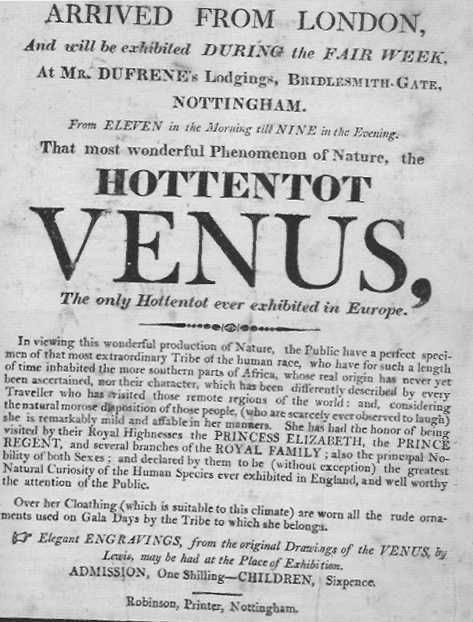
I read the word museum and I don’t think of preservation. I think of display. Of gawking onlookers and bodies catalogued and studied, colonial curiosity made science. I thought of Sarah Baartman, the Khoikhoi woman paraded across Europe, her sex organs treated as spectacle. Her anatomy dissected long before her death, her dignity buried long before her flesh; perhaps this is why I couldn’t conceptualise a world where the calf dies a quiet death. I remember too many bodies turned into exhibits.
What undid me, all those years I’d stumble across the poem online or in my photo gallery, was not the brevity of the calf’s life but the indignity I was certain awaited him. I did not trust the night to remain simple and beautiful. I expected tenderness to be interrupted. That reflex — to anticipate exposure, to assume that what is unusual will be punished — says more about how I move through the world than it does about a farm or a calf in a poem. The radical gift of that question in therapy was not optimism. It was the possibility that not every life outside the norm ends in humiliation, destruction, death. That some moments, however brief, are allowed to remain whole.
what a gift getting to hear your voice <3